Geopolitics: A Key Tool for Multidimensional Leadership
Contemporary public administration faces unprecedented challenges stemming from the obligation to govern local societies exposed to global dynamics. When a mayor, governor, or minister takes office, they often focus on the geographical boundaries of their jurisdiction, mistakenly believing that the solutions to their citizens' problems lie solely within those territorial limits.
Conversely, in an interconnected world, all administrative borders are permeable to economic, technological, migratory, and environmental flows that escape the control of traditional criteria of government, governance, and governability. Ignoring these forces weakens the effectiveness of management and leads to reactive actions by those in power, putting out fires instead of shaping the future.
This paper is an analytical journey to demonstrate why geopolitical science is not the exclusive domain of diplomats or the military, but rather the fundamental tool for the success of public administration at all levels. Geopolitics is a compass for power in a territory.
Understanding the value of this discipline involves stripping it of academic complexities to define it simply. Geopolitics is the study of how geographic space, with all its resources, climates, strategic positions, and populations, influences and interacts with political power and government decisions. It is a three-dimensional navigational map for public leaders.
Governing a territory is like captaining a ship on the high seas. An administrator who ignores geopolitics is like a captain who only looks at the deck, the engine, and the crew's discipline, but ignores ocean currents, trade winds, storms forming thousands of kilometers away, and the ports of call.
Thus, the ship may be immaculate inside, but it will run aground or be diverted from its course by external effects that the captain failed to anticipate. Similarly, geopolitics provides the ruler with binoculars to locate invisible currents that are useful to their community. Geopolitics transcends local asphalt to international corridors.
A practical example of this utility can be seen in the management of local infrastructure. Imagine a regional leader planning to build a river port or a logistics center for cargo. If that leader possesses geopolitical vision, they will analyze the dynamics of continental trade routes, what raw materials a power on the other side of the ocean is demanding, and how the planned infrastructure can be integrated into international corridors.
Geopolitical knowledge transforms a concrete structure into a strategic node of global development. Another clear example is found in food security and water management. A mayor of an agricultural municipality might think that the success of farmers depends on the local climate and state subsidies. However, an analysis of global geopolitical tensions can reveal in advance that a conflict in Eastern Europe will affect the price of fertilizers that their farmers import, allowing them to proactively promote native seed banks or cooperative organic fertilizer systems to mitigate the impact before the crisis erupts.
Geopolitical Criteria: An Anticipatory Mindset in the Face of Daily Urgency
This type of analysis leads to profound reflection on the true nature of strategic leadership. Theoretical knowledge is valuable, but it is completely sterile if it does not translate into cultivating a proactive and anticipatory mindset. Traditionally, the public administrator reacts to emergencies such as the day's social protest, the unexpected drop in tax revenue, or the collapse of a public service.
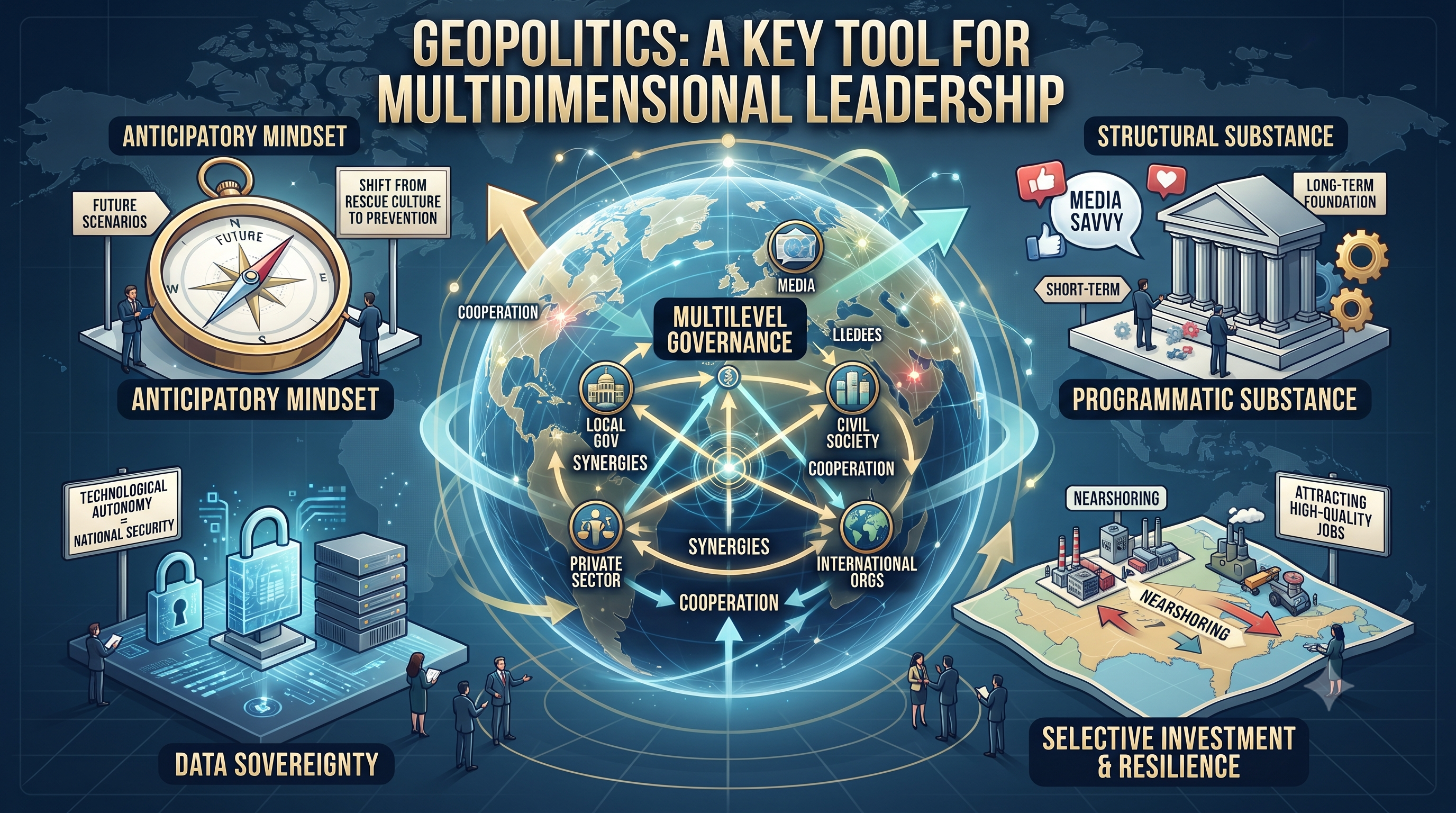
In contrast, the leader with a geopolitical mindset trains their mind to identify the subtle signals in the global environment that will ultimately impact their territory in the next five or ten years. Anticipating is not about predicting the future, but about constructing possible scenarios so that, when change occurs, the local government has contingency plans ready to implement. Proactivity redefines administrative efficiency, shifting from a culture of rescue to a culture of prevention and seizing opportunities.
Structural Substance vs. the Mirage of Networks
In current times, a dangerous confusion has taken root in democratic systems: equating good politics with mere media savvy and electoral success. Many leaders mistakenly believe that their main job is to manage narratives on social media, win public debates, and maintain high popularity ratings through catchy slogans.
While communication is a pillar of democracy, media savvy alone is an empty shell if it lacks programmatic substance. Effective and lasting politics conceives comprehensive solutions based on a deep understanding of territorial and global realities.
A viral video may win public sympathy for an afternoon, but it doesn't solve the water shortages caused by global climate change, nor does it create the technology jobs that local youth need in the face of international industrial automation. Geopolitics rescues public administration from media superficiality, forcing leaders to design public policies with solid, long-term structural foundations.
Multilevel Governance in a Globalized Environment
By intertwining geopolitics with state administration, the key concept of modern governance emerges, which is not exercised hierarchically and unidirectionally from a centralized office. Governing involves articulating complex networks where the public sector, private enterprise, civil society, and international organizations interact.
When we add a geopolitical perspective to this model, governance acquires a much richer and more powerful dimension. It allows local leaders to understand that the actors with whom they must negotiate are not only in their immediate surroundings.
A municipality seeking financing for a renewable energy project must understand the priorities of international green funds, the tensions between major powers regarding the energy transition, and global environmental standards. Geopolitics thus becomes the glue that binds local needs with global opportunities, facilitating multi-level governance where the local and the global mutually reinforce each other in a virtuous cycle.
Data sovereignty and technological autonomy
A crucial aspect that artificial intelligence and big data analytics allow us to add to this equation is the understanding of digital sovereignty and the geopolitics of data. Currently, data fuels the global economy. Through transportation systems, surveillance cameras, and online platforms, public administrations now collect millions of data points daily on the health, mobility, consumption, and security of their citizens. A public leader with a geopolitical vision knows where this data is stored, who owns the technological infrastructure used by their government, and what the implications are of depending on foreign corporations for the management of essential public services. The technological autonomy of a region or municipality is a matter of national and local security. Integrating geopolitics into public software means ensuring that control of citizen information remains at the service of social welfare and is not used as a tool for pressure or espionage by external actors.
Institutional Responses to Climate Change
Likewise, climate risk management is another area where geopolitics applied to public administration is indispensable. Climatic phenomena do not respect political-administrative divisions. A prolonged drought in a watershed shared by several regions can unleash internal conflicts over access to water, affecting energy production and paralyzing regional industry.
The public administrator who incorporates environmental geopolitics does not limit themselves to planting trees in their locality. It coordinates with the leaders of neighboring territories to create joint conservation districts, understand water diplomacy, and anticipate internal climate migrations that will eventually reach their cities in search of better living conditions. Political ecology and the geopolitics of natural resources offer scientific answers that traditional bureaucracy often ignores because it is focused on daily paperwork.
Strategies for selectively attracting investment
Adopting this science attracts investment and territorial economic development. Instead of going out into the world to offer blind tax incentives for any company to set up in their region, the leader with geopolitical training maps global value chains. They understand which technological or industrial components are seeking to relocate due to trade tensions between major economic powers, a phenomenon known in the markets as proximity relocation or nearshoring.
By identifying these trends, public administrations can adapt their local education systems, improve their connectivity infrastructure, and offer a secure environment for industries that require geopolitical stability. In this way, the territory ceases to be a passive spectator of globalization and becomes an active and selective magnet for investments that generate high-quality employment and real technology transfer.
Decentralization of State Strategic Thinking
For this transformation to be lasting, it is essential to decentralize strategic thinking within the very structure of the State. A geopolitical mindset should not be confined to ministries of foreign affairs or defense. Every municipal planning director, every regional economic development secretary, and every local budget officer needs to incorporate global variables into their decision-making frameworks.
This requires a quiet but profound reform in the training of career civil servants, promoting curricula that address economic geography, the history of international relations, and prospective analysis. When the technical staff of a public administration understands the global environment, territorial development plans cease to be mere electoral wish lists and become strategic roadmaps resilient to global economic fluctuations.
Protecting Identity in the Age of Hyperconnectivity
Hand in hand with artificial intelligence, integrating geopolitics with public service strengthens the social fabric and community identity against the destabilizing impacts of hyperconnectivity. Immediate access to global information often fragments local identities or exposes citizens to disinformation campaigns designed to destabilize democratic institutions.
A leader aware of these realities uses tools of cultural geopolitics to protect and enhance the intangible assets of their community, such as traditions, gastronomy, and artistic expressions, transforming them into factors of internal cohesion and international projection with a territorial brand. This comprehensive appreciation of what is one's own in the face of what is foreign allows communities to integrate into global modernity without losing their roots, achieving a harmonious balance between openness to the world and safeguarding local cultural sovereignty.
Conclusions on Multidimensional Leadership and Geopolitical Foresight
As a synthesis of the above, four fundamental conclusions are drawn regarding the importance of geopolitics for multidimensional leadership in public administration.
1. Geopolitics acts as a definitive antidote to administrative myopia, enabling leaders to design public policies with a long-term vision, overcoming short-sighted perspectives conditioned by electoral cycles.
2. Understanding and applying geopolitics equips public leaders with superior predictive and adaptive capabilities, transforming government management from a reactive and corrective model to proactive strategies for mitigating global risks before they affect local well-being.
3. Geopolitics redefines the practice of modern governance by expanding the scope of action for public administrators, facilitating the creation of multi-level strategic alliances and the successful integration of the territory into global economic and technological dynamics. 4. The application of this discipline restores analytical rigor and scientific integrity to politics, demonstrating that the true effectiveness of a government lies not in the control of momentary media narratives, but in the structural capacity to transform geographical and social reality for the permanent benefit of the citizenry.
About the Author: Lieutenant Colonel Luis Alberto Villamarín Pulido is a veteran officer of the Colombian Army and a renowned international analyst of strategic affairs, geopolitics, and national security. He is the author of more than 40 books on the Colombian conflict and international terrorism. He is also an international speaker and expert consultant on defense and military leadership for the world's most prominent Spanish-language media outlets
Comentarios
Inicie sesión para participar en la conversación.
Iniciar Sesión